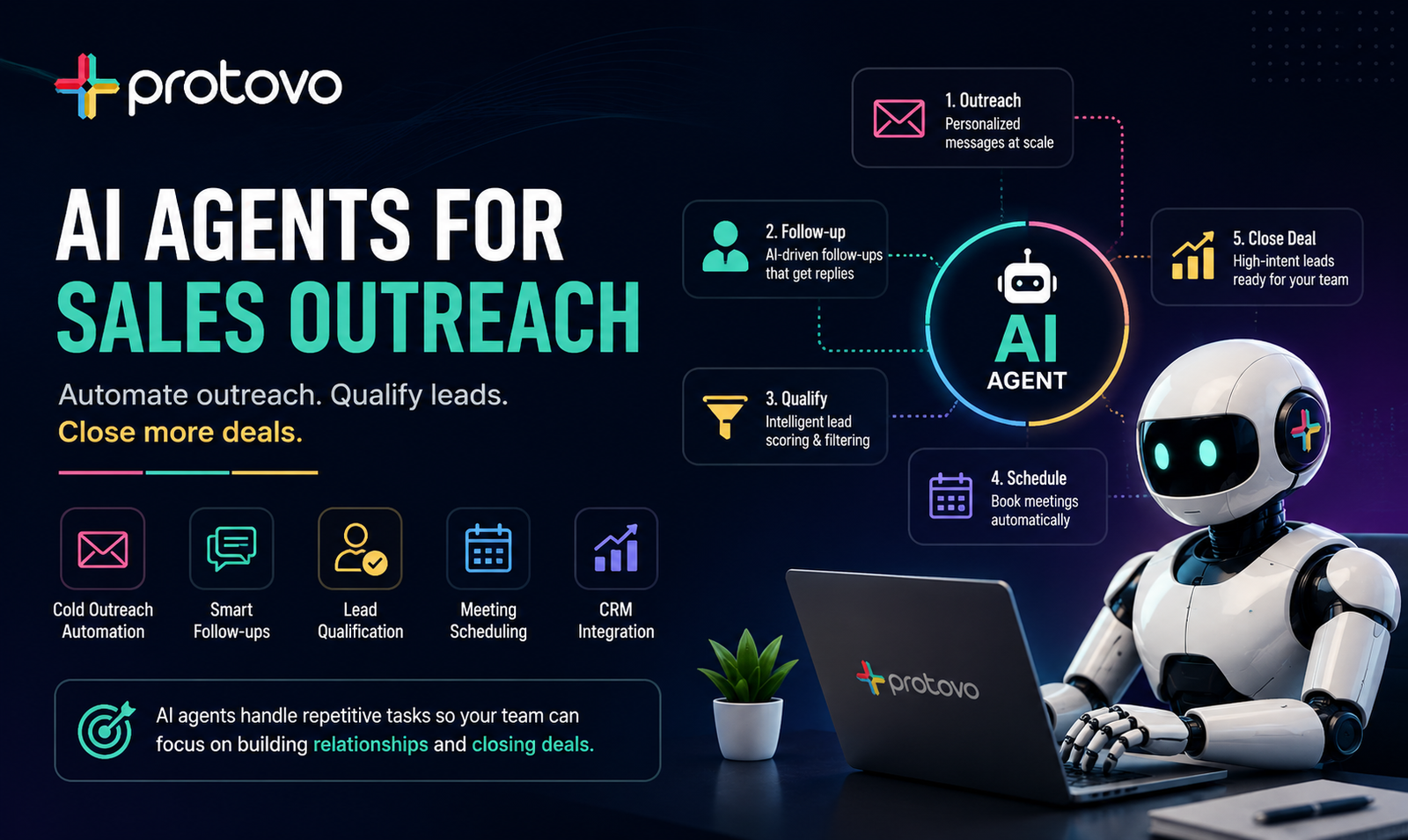

AI Agents for Sales Outreach: A Practical Approach to Scalable Lead Generation
How businesses can structure, automate, and optimize sales outreach using AI agents without increasing operational complexity
Sales outreach remains one of the most resource-intensive functions in any organization. Teams spend hours identifying prospects, sending cold emails, following up, and qualifying leads, often with inconsistent results.
Despite investments in CRM systems and sales tools, a significant portion of outreach still depends on manual effort. This creates gaps in response time, follow-up consistency, and lead prioritization.
AI agents introduce a structured way to handle these challenges. Instead of replacing sales teams, they handle repetitive and time-sensitive tasks, allowing human teams to focus on conversations and conversions.
This blog explores how AI agents can be implemented in sales outreach with a clear focus on execution, system design, and business outcomes.
Understanding AI Agents in Sales Outreach
What AI Agents Actually Do
AI agents are designed to manage specific parts of the sales workflow autonomously. Their role is not limited to sending automated messages. They operate across multiple stages of the outreach lifecycle.
Core capabilities include:
- Prospect identification and data enrichment
- Personalized message generation
- Multi-step follow-up sequences
- Lead qualification through interaction analysis
- Meeting scheduling and CRM updates
They operate based on predefined logic combined with adaptive learning from interactions.
Structuring an AI-Driven Sales Outreach System
Layer 1: Lead Identification and Enrichment
Before outreach begins, the quality of data determines the outcome.
Key considerations:
- Source reliable lead databases
- Enrich data with company size, role, and industry
- Segment leads based on relevance and intent
Without structured input data, AI agents cannot deliver meaningful output.
Layer 2: Personalized Outreach Engine
AI agents generate outreach messages that align with context rather than using static templates.
Execution approach:
- Use variables such as role, industry, and recent activity
- Maintain consistent tone aligned with brand communication
- Avoid over-personalization that feels artificial
The objective is relevance, not volume.
Layer 3: Follow-Up Automation
Follow-ups are often inconsistent in manual systems. AI agents ensure continuity.
System design includes:
- Trigger-based follow-ups based on user behavior
- Time-based sequences for non-responsive leads
- Context-aware messaging adjustments
This ensures no lead is left unattended.
Layer 4: Lead Qualification Logic
AI agents filter leads before they reach the sales team.
Qualification can be based on:
- Engagement signals such as replies and clicks
- Responses to qualifying questions
- Behavioral patterns across interactions
This reduces time spent on low-intent prospects.
Layer 5: CRM and Workflow Integration
AI agents must integrate with existing systems to maintain operational consistency.
Integration points:
- CRM platforms for lead tracking
- Calendar systems for scheduling
- Notification systems for sales teams
A disconnected AI system creates more complexity instead of reducing it.
Decision Factors Before Implementing AI Agents
Data Readiness
- Is your lead data structured and reliable
- Are segmentation criteria clearly defined
Process Clarity
- Is your sales workflow documented
- Are qualification rules standardized
System Integration
- Can your CRM support automation workflows
- Are APIs available for integration
Monitoring and Control
- Do you have visibility into AI decisions
- Can you override or refine workflows
Without these, AI implementation may lead to inconsistent outcomes.
Common Implementation Mistakes
- Treating AI as a replacement instead of a support layer
- Using generic outreach without segmentation
- Ignoring data quality and enrichment
- Over-automating without human checkpoints
- Not measuring performance metrics
AI systems require structure. Without it, they amplify inefficiencies.
Why This Matters
Sales outreach directly impacts revenue generation. Inefficient outreach leads to missed opportunities, delayed responses, and wasted effort.
Key business impacts:
- Reduced response rates due to inconsistent communication
- Increased cost per lead due to manual effort
- Poor pipeline quality due to weak qualification
- Slower conversion cycles
AI agents address these issues by introducing consistency, speed, and structured decision-making into the outreach process.
Protovo Perspective
At Protovo, AI implementation is approached as a system design problem rather than a tool deployment.
The focus is on:
- Structuring the sales workflow before introducing automation
- Defining clear qualification logic and data flows
- Ensuring integration with existing CRM and operational systems
- Maintaining human oversight where decision quality matters
AI agents are positioned as an extension of the sales process, not an isolated solution.
This approach ensures that automation improves clarity instead of adding complexity.
Conclusion
AI agents are redefining how sales outreach is executed, but the value lies in how they are implemented.
Organizations that treat AI as a structured system will see improvements in efficiency, consistency, and scalability.
Those that adopt AI without process clarity will struggle with fragmented workflows and unreliable outcomes.
The long-term advantage will belong to businesses that combine automation with disciplined execution.
FAQ Section
What is an AI sales agent?
An AI sales agent is a system that automates outreach tasks such as sending messages, following up, qualifying leads, and updating CRM systems.
Can AI agent replace sales teams?
No. AI agents handle repetitive tasks, allowing sales teams to focus on conversations, relationship building, and closing deals.
How do AI agents qualify leads?
They analyze engagement, responses, and predefined criteria to determine whether a lead is relevant and ready for sales interaction.
Do AI agents work with existing CRM systems?
Yes. Most AI systems are designed to integrate with CRM platforms for tracking, updates, and workflow automation.
Is AI outreach better than manual outreach?
AI outreach improves consistency and speed, but effectiveness depends on data quality, segmentation, and system design.
What industries can use AI sales agents?
Any industry that relies on lead generation and outreach can benefit, including IT services, SaaS, consulting, and real estate.
What is required before implementing AI agents?
Clear sales processes, structured data, defined qualification rules, and integration readiness are essential before implementation.
If you are planning to structure or scale your sales outreach using AI agents,
feel free to reach out for a focused discussion on how to approach it effectively.
About Us

Useful Resources