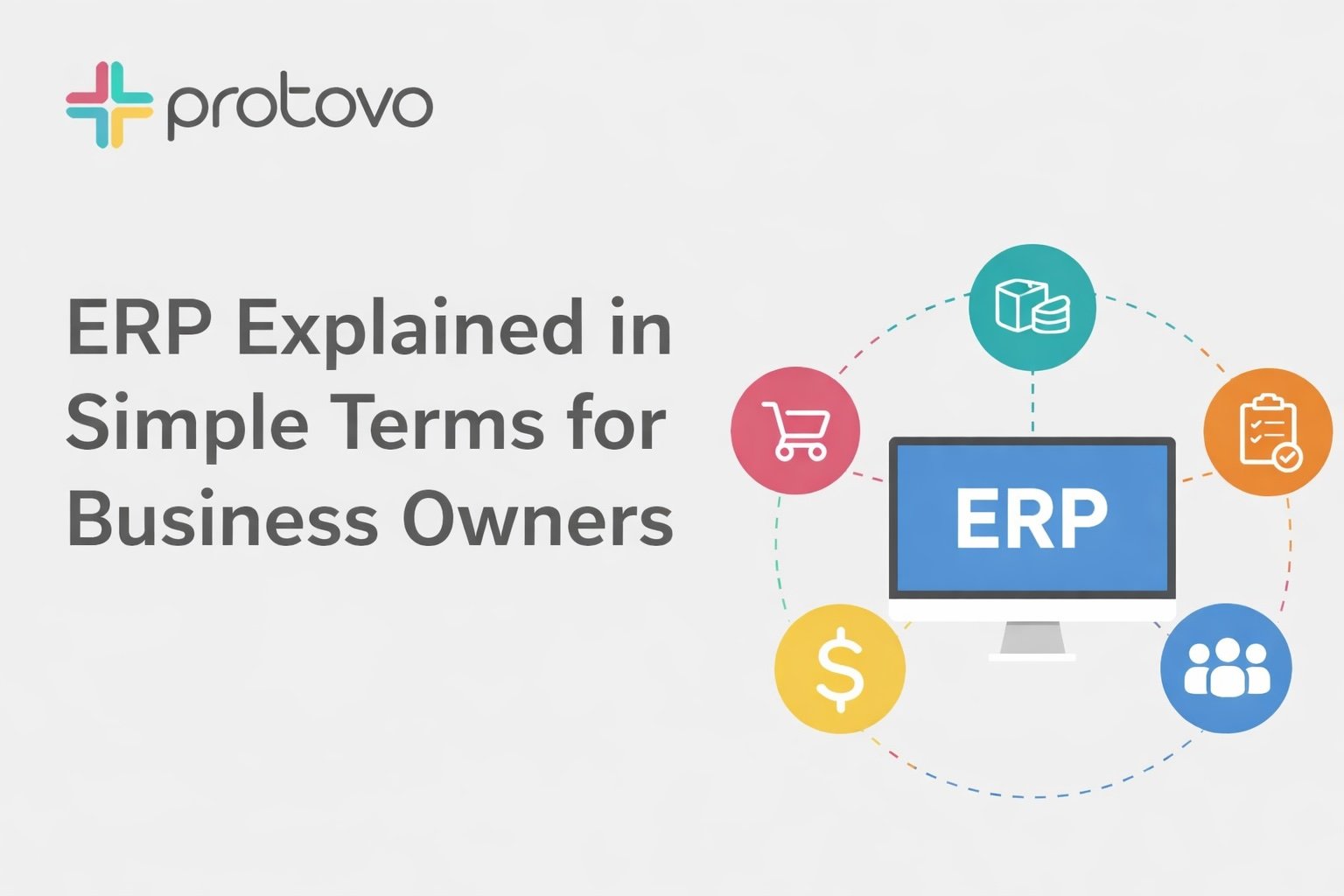

ERP Explained in Simple Terms for Business Owners
Understanding ERP Without Technical Complexity
Many businesses do not fail because of poor products or weak teams. They struggle because their systems do not scale with growth.
Sales, operations, finance, and inventory often work in separate tools. Data is entered multiple times. Reports do not match. Decisions are delayed or based on incomplete information.
ERP exists to solve this structural problem.
This article explains ERP in simple terms so business owners, founders, and operational leaders can understand what ERP actually does and when it becomes necessary.
What ERP Actually Means
ERP in simple language
ERP stands for Enterprise Resource Planning.
In simple terms, ERP is one system that connects your core business activities so everyone works with the same data.
Instead of using separate tools for different departments, ERP brings them together in one structured platform covering:
-
Sales and customer orders
-
Purchasing and supplier management
-
Inventory and warehouses
-
Finance and accounting
-
Operations and production
-
Human resources and payroll
ERP does not replace people. It replaces confusion between teams.
What Problem ERP Solves
The real issue is disconnected systems
As businesses grow, common problems appear:
-
The same data is entered in multiple places
-
Numbers differ between departments
-
Manual approvals slow down work
-
Reports take too long and lack clarity
-
Operations depend heavily on a few individuals
ERP solves this by creating a single source of truth.
When one activity happens, related functions update automatically. Sales affects inventory. Inventory affects purchasing. Purchasing affects finance.
Everything stays aligned.
What ERP Is Not
ERP is often misunderstood, which leads to poor decisions.
ERP is not:
-
Just accounting software
-
A reporting tool alone
-
A quick fix for broken processes
-
A replacement for management discipline
ERP strengthens existing processes. If processes are unclear, ERP will expose those gaps rather than hide them.
When a Business Should Consider ERP
Signs that ERP is needed
ERP is usually driven by complexity, not company size.
Common signals include:
-
Heavy dependence on spreadsheets and emails
-
Inventory mismatches or delivery delays
-
Difficulty tracking costs or margins
-
Slow financial closing cycles
-
Manual coordination between departments
For manufacturing, logistics, and fleet-based operations, ERP often becomes necessary earlier due to operational dependencies.
How ERP Works in Daily Operations
A simple example
-
A customer places an order
-
Sales enters the order once
-
Inventory availability updates automatically
-
Production or dispatch is triggered
-
Finance records revenue and cost
-
Management sees real-time status
There is no duplicate entry and no manual follow-up across teams. This is the practical value ERP delivers.
ERP Value for Different Roles
For founders and owners
-
Clear visibility into performance
-
Reduced dependency on individuals
-
Better control during growth
For operations leaders
-
Predictable workflows
-
Fewer manual interventions
-
Better planning and execution
For manufacturing and fleet teams
-
Accurate inventory and scheduling
-
Clear production or dispatch plans
-
Operational cost visibility
For IT and enterprise teams
-
Centralized systems
-
Controlled integrations
-
Improved data governance
Why This Matters
ERP directly impacts how a business scales.
Without ERP:
-
Growth increases operational friction
-
Errors multiply across teams
-
Decision-making slows down
With ERP:
-
Processes become repeatable
-
Data becomes reliable
-
Leadership gains clarity and control
ERP is not about automation alone. It is about building a stable operational foundation.
Protovo Perspective
Protovo approaches ERP as a business structure initiative, not a software installation.
The focus remains on:
-
Understanding real workflows before system design
-
Aligning departments around shared processes
-
Selecting ERP architecture based on operational needs
-
Implementing in phases to reduce disruption
ERP should support how the business actually runs, not force teams to work around the system.
Final Perspective
ERP is not required on day one.
But for growing organizations, there comes a point where fragmented systems slow progress and hide performance issues.
When implemented with clarity and discipline, ERP becomes a long-term foundation for operational stability, scalability, and confident decision-making.
Frequently Asked Questions
What is ERP in simple terms
ERP is one system that connects sales, operations, inventory, finance, and other core business functions.
Is ERP only for large companies
No. ERP is for businesses with operational complexity, not just large organizations.
Does ERP replace staff
No. ERP supports teams by reducing manual work and improving coordination.
How long does ERP implementation take
Timelines depend on scope and readiness. Phased implementation is usually more effective.
Is ERP expensive
Cost depends more on planning and execution than on the software itself.
Can ERP be customized
ERP can be configured to fit business processes. Excessive customization should be avoided.
If you are considering ERP or unsure whether your business is ready, start with a clear conversation about structure and processes.
Reach out if you want to discuss readiness, scope, or next steps without jumping into tools.
About Us

Useful Resources