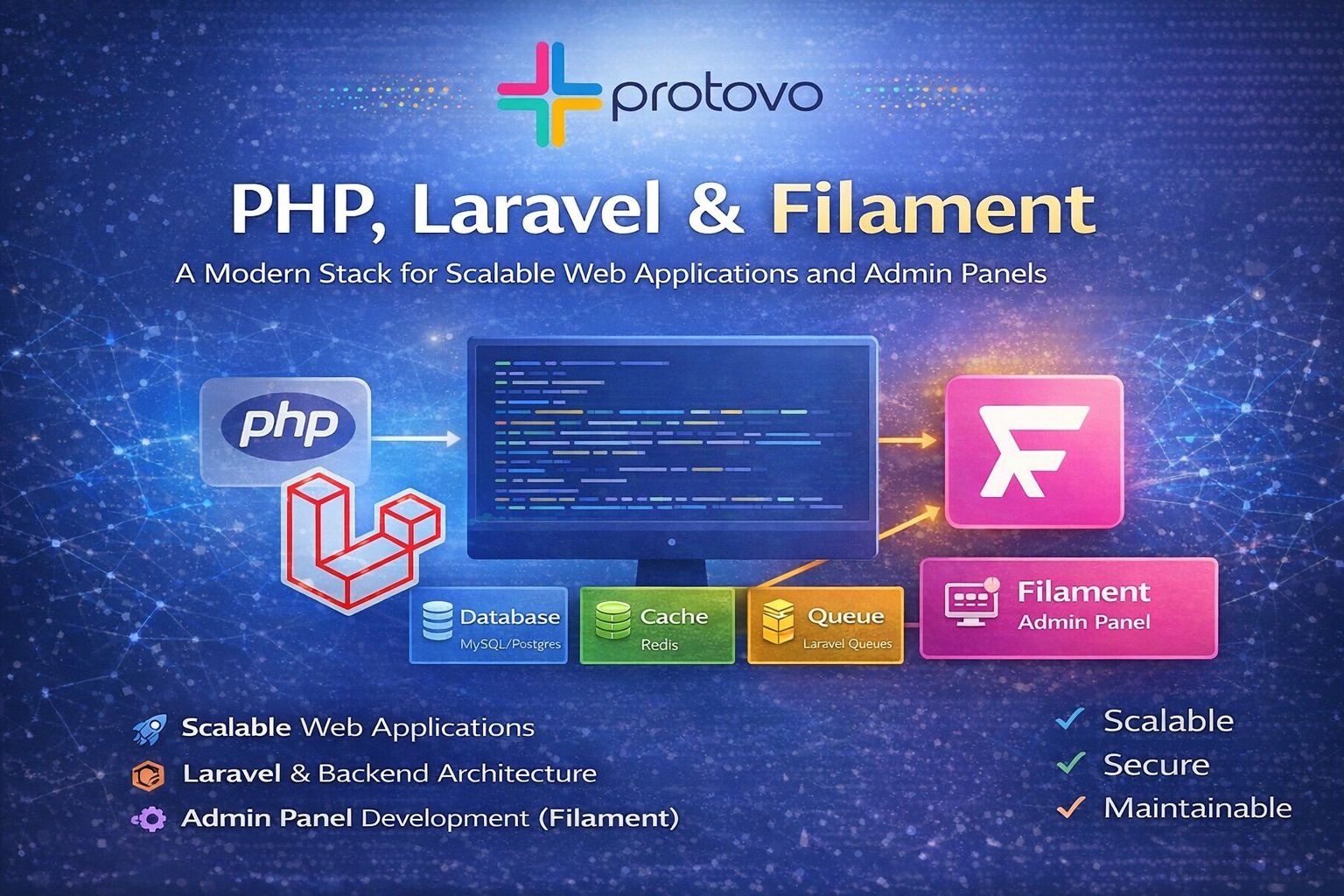

PHP, Laravel & Filament
A CTO’s Perspective on Building Scalable Backend and Admin Systems
For CTOs, technology choices are not about frameworks.
They are about risk, scalability, maintainability, and team efficiency.
The PHP, Laravel, and Filament stack continues to be a strong choice for organizations that need:
-
Predictable delivery
-
Clean backend architecture
-
Fast development without long-term debt
-
Maintainable admin and operational systems
This article evaluates the stack from a technical leadership lens, focusing on architecture, trade-offs, and execution patterns.
Why PHP Still Belongs in Serious Backend Systems
PHP remains relevant because it has matured into a stable, performant backend language when used with discipline.
From a CTO standpoint, PHP offers:
-
Predictable runtime behavior
-
Strong backward compatibility
-
Mature ecosystem and hosting flexibility
-
Large, hire-ready developer pool
Modern PHP, when combined with strong architectural practices, supports enterprise-grade workloads without unnecessary complexity.
Laravel as an Application Architecture Framework
Laravel is not just a PHP framework.
It is an opinionated application architecture layer.
Key architectural advantages:
-
Enforced MVC separation
-
Native support for service containers and dependency injection
-
First-class support for queues, events, and background jobs
-
Integrated security primitives for authentication and authorization
-
API-first capabilities with clean routing and middleware layers
Laravel reduces architectural ambiguity, which directly lowers long-term maintenance risk.
Filament: Admin Architecture Without Frontend Debt
Admin interfaces are where systems degrade fastest.
Traditional admin dashboards accumulate:
-
Excessive frontend complexity
-
Inconsistent UX patterns
-
Hard-to-maintain custom components
Filament changes the model by:
-
Keeping admin logic close to backend domain models
-
Reducing dependency on heavy frontend frameworks
-
Enforcing consistent resource-based patterns
-
Supporting RBAC and policy-driven access control
For CTOs, Filament is not about speed alone.
It is about controlling internal system entropy.
Architectural Fit: When This Stack Makes Sense
This stack is particularly effective when:
-
Admin workflows are complex and business-driven
-
Internal tools matter as much as customer-facing UX
-
Teams want to minimize frontend surface area
-
Long-term maintainability outweighs novelty
Typical use cases include:
-
SaaS platforms with heavy internal operations
-
ERP, CRM, and workflow systems
-
Fintech back-office systems
-
Logistics and fleet management platforms
System Design Considerations for Scale
Using Laravel and Filament at scale requires architectural discipline.
Key design principles we apply:
-
Domain-driven separation of business logic
-
Thin controllers and service-layer abstraction
-
Asynchronous processing using queues
-
API-first boundaries for external integrations
-
Strict authorization policies at model level
Filament fits naturally into this model by acting as a controlled interface layer, not a separate application.
Performance and Scalability Realities
Laravel and PHP scale well when:
-
Database access is optimized and indexed
-
Heavy operations are offloaded to queues
-
Caching layers are applied strategically
-
Stateless APIs are used where possible
Filament does not introduce significant overhead when resource queries and permissions are designed correctly.
The bottleneck is rarely the framework.
It is almost always architecture or data modeling.
Security and Governance Considerations
From a CTO perspective, governance matters.
Laravel and Filament support:
-
Policy-based access control
-
Centralized authentication mechanisms
-
Secure API token management
-
Audit-friendly admin workflows
This makes the stack suitable for regulated industries when combined with proper infrastructure controls.
Team Productivity and Hiring Signal
Technology decisions affect hiring and delivery velocity.
This stack offers:
-
Strong developer onboarding speed
-
Clear conventions and patterns
-
Easier code reviews due to structure
-
Lower cognitive load for admin feature development
This translates directly into lower delivery risk.
Trade-Offs and Honest Limitations
No stack is universal.
Consider alternatives if:
-
You require heavy real-time frontend interactions
-
Admin UX demands extreme customization
-
Your team is heavily frontend-first
However, for backend-heavy and operations-driven systems, this stack remains highly efficient.
Final CTO Perspective
PHP, Laravel, and Filament represent a pragmatic engineering choice.
They prioritize:
-
Clarity over novelty
-
Maintainability over hype
-
Execution over experimentation
For CTOs responsible for systems that must survive years of growth, this stack provides a stable foundation with controlled complexity.
At Protovo Solutions, we recommend and implement this stack where architecture discipline and operational scalability matter more than trends.
CTO FAQ
Is Laravel suitable for large, long-lived systems?
Yes. Laravel supports large systems when domain boundaries, service layers, and async processing are applied correctly.
Does Filament limit frontend flexibility?
For admin systems, Filament intentionally limits frontend freedom to improve consistency, performance, and maintainability.
Can this stack support SaaS scale?
Yes, especially for SaaS products with operational dashboards, workflows, and multi-tenant architectures.
How does this stack impact long-term technical debt?
When used with clean architecture principles, it reduces technical debt by enforcing structure and conventions.
Is this stack future-proof?
The ecosystem maturity, community size, and backward compatibility make it a low-risk long-term choice.
If you are evaluating backend architecture, admin systems, or SaaS platform foundations, the conversation should start with structure, not features.
💬 Connect with Protovo to review your Laravel or Filament architecture from a CTO lens.
About Us

Useful Resources